Choline is one of the most important nutrients for a child’s developing brain, and one of the least talked about. The U.S. Institute of Medicine only formally recognized it as an essential nutrient in 1998, decades after vitamins like D and C entered the public vocabulary. That late start shows. National intake surveys consistently find that the large majority of children consume less choline than the recommended Adequate Intake (AI).
What choline actually does
Choline is a structural building block. The body uses it to make phosphatidylcholine, a primary component of every cell membrane, and acetylcholine, a neurotransmitter central to memory, attention, and muscle control. During childhood, when the brain is forming synapses faster than at any other point in life, the demand for these materials is high.
Three roles stand out during development:
- Memory and learning. Acetylcholine is the principal neurotransmitter of the hippocampus, the brain’s memory-formation hub.
- Cell structure. Phosphatidylcholine and sphingomyelin, both choline-dependent, make up the membranes and myelin that insulate developing neurons.
- Methylation. Choline donates methyl groups that regulate how genes are switched on and off, a process especially active in early development.
Why kids fall short
Choline is concentrated in foods many children avoid. The richest sources are egg yolks, liver, and organ meats, followed by meat, fish, and some beans. A single large egg supplies roughly 147 mg of choline, most of it in the yolk. For a picky eater who skips eggs and meat, hitting the recommended intake from food alone is genuinely difficult.
The result is a well-documented gap. Analyses of national dietary data have repeatedly found that most children and adolescents consume below the AI for choline, and that few kids’ multivitamins meaningfully fill it.
Why most kids’ vitamins skip it
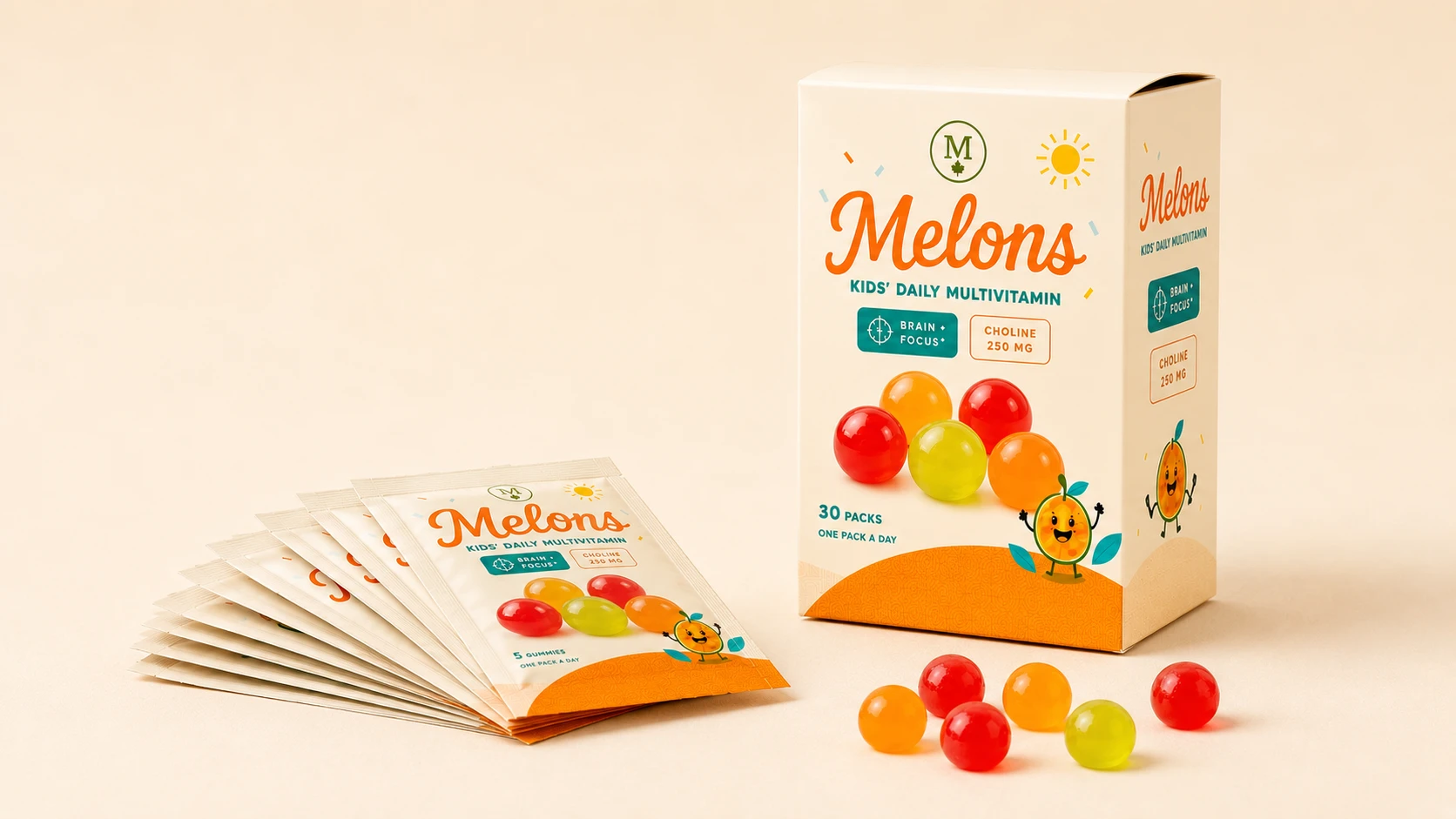
Choline is bulky. A meaningful dose takes up real physical space, far more than the microgram quantities of most vitamins. In a single small gummy or pill, there isn’t room for it alongside everything else, so most formulators leave it out or include a token amount. This is the central trade-off behind the Melons format: spreading the daily serving across five gummies makes room for a real choline dose that a single pill cannot physically carry.
What an adequate dose looks like
Recommended Adequate Intake for choline rises with age. For children 4 to 8 years, the AI is 250 mg per day; for ages 9 to 13 it is 375 mg. On a Supplement Facts panel, the Daily Value reference used for labeling is 550 mg, so a 250 mg serving is listed as 45% of the Daily Value, and qualifies as an “excellent source” under FDA labeling rules.
A note on safety: choline also has a Tolerable Upper Intake Level (1,000 mg/day for young children), which a food-plus-supplement intake in this range stays well below.
This article is for general education and is not medical advice. Dietary supplements are not intended to diagnose, treat, cure, or prevent any disease. Talk to your pediatrician about your child’s individual needs.
References
- National Institutes of Health, Office of Dietary Supplements. Choline: Fact Sheet for Health Professionals.
- Institute of Medicine. Dietary Reference Intakes for Folate, Choline, and Related B Vitamins.
- Wallace TC, Fulgoni VL. Usual Choline Intakes Are Associated with Egg and Protein Food Consumption in the United States.